Introduction
Slide deck 1. Course intro: security definitions, attacks, services, mechanisms and the two security models.
 Introduction to Cryptography and Network SecurityNeso Academy · why network security matters, with a real example, 10 min
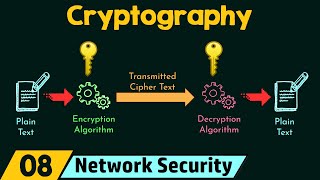 CryptographyNeso Academy · what cryptography is and where it is used, 14 min
 Cryptography – Key TermsNeso Academy · plaintext, ciphertext, key, cryptanalysis and other key terms, 10 min
 Lecture 1: Introduction to Cryptography by Christof PaarIntroduction to Cryptography by Christof Paar · full university lecture: crypto overview and the substitution cipher, 77 min
Course backgroundSearch on YouTube
Course aimSearch on YouTube
The course is CSS411: Cryptography and Network Security. It studies how to protect information during transmission and storage.
The focus of the course is Internet Security. It consists of measures to deter, prevent, detect, and correct security violations that involve the transmission and storage of information.
Changed requirementsSearch on YouTube
Information security requirements changed in recent times:
- Traditionally, security came from physical and administrative mechanisms.
- Computer use needs automated tools to protect files and other stored information.
- Networks and communication links need measures to protect data during transmission.
DefinitionsSearch on YouTube
| Term | Definition |
|---|---|
| Computer Security | Generic name for the collection of tools designed to protect data and to thwart hackers |
| Network Security | Measures to protect data during their transmission |
| Internet Security | Measures to protect data during their transmission over a collection of interconnected networks |
Two quiz slides open the deck. Cryptography is a Greek word that means secret writing (not corrupting data, open writing, or closed writing). The process that transforms a message to unreadable form is encryption (not compression or hiding).
Security attacksSearch on YouTube
Three aspects of securitySearch on YouTube
The slides consider three aspects of information security:
- Security attack: any action that compromises the security of information owned by an organization.
- Security mechanism: a feature that detects, prevents, or recovers from a security attack.
- Security service: a service that counters security attacks. It uses one or more security mechanisms.
Information security prevents attacks on information-based systems. If prevention fails, information security detects the attacks. The slides use threat and attack to mean the same thing most of the time. There is a wide range of attacks, so the slides focus on two generic types: passive and active.
Passive = reading a letter. Active = forging, delaying, or destroying a letter. Reading leaves no trace, so detection is hard. Changing leaves damage, but the many weak points make prevention hard.
Passive attacksSearch on YouTube
Passive attacks are eavesdropping on, or monitoring of, transmissions. The goal of the opponent is to obtain information that is being transmitted. The slide shows Darth, who reads the contents of a message from Bob to Alice. The message does not change, so detection is very difficult.
| Type | What happens |
|---|---|
| Release of message contents | The opponent reads the contents of a transmitted message |
| Traffic analysis | The opponent cannot read an encrypted message. The opponent observes the pattern (size, frequency, source, destination) and guesses the nature of the communication |
The two passive attacks: Release of message contents, then Traffic analysis. Hook: "Real Traffic". If encryption hides the contents, the attacker falls back on traffic analysis.
Active attacksSearch on YouTube
Active attacks involve some modification of the data stream or the creation of a false stream. They are difficult to prevent because of the wide variety of physical, software, and network vulnerabilities. The goal is to detect attacks and to recover from any disruption or delays that they cause.
| Type | Description |
|---|---|
| Masquerade | One entity pretends to be a different entity. Usually includes one of the other forms of active attack |
| Replay | Passive capture of a data unit and its subsequent retransmission to produce an unauthorized effect |
| Modification of messages | Some portion of a legitimate message is altered, or messages are delayed or reordered, to produce an unauthorized effect |
| Denial of service | Prevents or inhibits the normal use or management of communications facilities |
The slide shows replay in two phases. Darth captures a message from Bob to Alice. Later, Darth replays the message to Alice.
Order of the four active attacks: M, R, M, D, "MaReMoD". Hook: a Masquerader Replays and Modifies messages to cause Denial of service.
Four attack categoriesSearch on YouTube
The slides show four more attack categories with pictures:
| Category | Meaning (slide text) | Picture labels |
|---|---|---|
| Interruption | Services or data become unavailable, unusable, destroyed, and so on, such as loss of a file or denial of service | Cut wire lines, jam wireless signals, drop packets |
| Interception | An unauthorized subject gains access to an object, such as stealing data or overhearing the communication of others | Wiring, eavesdrop |
| Modification | Unauthorized changing of data or tampering with services, such as alteration of data or modification of messages | Intercept, then replaced info |
| Fabrication | Additional data or activities are generated that would normally not exist, such as adding a password to a system or replaying previously sent messages | Also called impersonation |
Each category attacks one security property (standard textbook mapping):
Interception (eavesdropping) is passive. Interruption, modification, and fabrication are active. Replay is an example of fabrication on the slide: old data that would not exist otherwise.
Security servicesSearch on YouTube
What a service doesSearch on YouTube
A security service has these properties:
- It enhances the security of data processing systems and information transfers of an organization.
- It is intended to counter security attacks.
- It uses one or more security mechanisms.
- It often replicates functions of physical documents. Such documents have signatures and dates. They need protection from disclosure, tampering, or destruction. They are notarized or witnessed, recorded, or licensed.
The five servicesSearch on YouTube
| Service | Meaning |
|---|---|
| Authentication | Assurance that the communicating entity is the one claimed |
| Access Control | Prevention of the unauthorized use of a resource |
| Data Confidentiality | Protection of data from unauthorized disclosure |
| Data Integrity | Assurance that data received is as sent by an authorized entity |
| Non-Repudiation | Protection against denial by one of the parties in a communication |
The five services in slide order: A, A, C, I, N. Hook: "AACIN: All Accounts Checked, In order, Now". Authentication proves identity. Access control keeps users out. Confidentiality hides. Integrity keeps data unchanged. Non-repudiation blocks the "it was not me" excuse.
Exam pattern: "match the attack to the service". Masquerade needs authentication. Modification needs integrity. Eavesdropping needs confidentiality. Non-repudiation handles disputes between the two legitimate parties.
Security mechanismsSearch on YouTube
What a mechanism doesSearch on YouTube
A security mechanism is a feature designed to detect, prevent, or recover from a security attack.
- No single mechanism supports all the services required.
- One element underlies many of the mechanisms in use: cryptographic techniques. This is why the course focuses on cryptography.
Specific mechanismsSearch on YouTube
The slide lists eight specific mechanisms. The purpose column is a standard textbook summary.
| Specific mechanism | Purpose |
|---|---|
| Encipherment | Cryptographic conversion of data |
| Digital signature | Proof of origin and integrity attached to data |
| Access control | Rights that limit who uses each resource |
| Data integrity | Detects modification of data |
| Authentication exchange | Two entities exchange messages to prove identity |
| Traffic padding | Adds dummy data so that traffic analysis fails |
| Routing control | Selects secure routes, for example around an insecure subnetwork |
| Notarization | A trusted third party certifies properties of a data exchange |
Pervasive mechanismsSearch on YouTube
| Pervasive mechanism | Purpose |
|---|---|
| Trusted functionality | Functions that are accepted as correct and secure |
| Security labels | Marks that show the security level of a resource |
| Event detection | Detects security-relevant events |
| Security audit trail | Records security-relevant data for later review |
| Security recovery | Actions that restore the system after an event |
The specific list answers "what defends the data". The pervasive list answers "what defends the system". Pervasive: Trusted, Labels, Event, Audit, Recovery, "TLEAR".
Security modelsSearch on YouTube
Network security modelSearch on YouTube
The slide draws the model with these elements:
| Element | Role |
|---|---|
| Sender and recipient | The principals that exchange the message |
| Security-related transformation | Changes the message into a secure message, and back |
| Secret information | The keys that drive the transformation on each side |
| Trusted third party | For example, an arbiter or a distributor of secret information |
| Opponent | The attacker on the channel |
| Information channel | Carries the secure message |
To use this model, do these four tasks:
- Design a suitable algorithm for the security transformation.
- Generate the secret information (keys) that the algorithm uses.
- Develop methods to distribute and share the secret information.
- Specify a protocol that lets the principals use the transformation and secret information for a security service.
Four jobs, in slide order: invent the lock (algorithm). Cut the key (generate secrets). Deliver the key safely (distribution). Write the rulebook (protocol).
Network access security modelSearch on YouTube
The second model guards access to an information system. The opponent is a human (for example, a cracker) or software (for example, a virus or worm). The opponent comes in through the access channel.
The information system holds computing resources (processor, memory, I/O), data, processes, and software. It has two lines of defense:
- Gatekeeper function: stands at the access channel and identifies users.
- Internal security controls: protect the resources inside the system.
To use this model, do these two tasks:
- Select appropriate gatekeeper functions to identify users.
- Implement security controls so that only authorized users access designated information or resources.
Trusted computer systems may help to implement this model.
The two models have different task lists. The network security model has four tasks. The network access security model has two tasks. Exam questions often ask for the tasks of one specific model.
Quick self-testSearch on YouTube
What does the word cryptography mean, from the Greek origin?
Secret writing. The quiz options were corrupting data, secret writing, open writing, and closed writing. The process that transforms a message to unreadable form is encryption.
Name the three aspects of information security.
Security attack, security mechanism, and security service. An attack compromises the security of information. A mechanism detects, prevents, or recovers from an attack. A service counters attacks with one or more mechanisms.
Give the two types of passive attacks and one line for each.
Release of message contents: the opponent reads the transmitted contents. Traffic analysis: encryption hides the contents, so the opponent observes message patterns. From these patterns, the opponent guesses the nature of the communication.
Why are passive attacks hard to detect?
No data changes, so no trace remains. The attacker only observes. Thus the defense is prevention, for example encryption.
Name and define the four types of active attacks.
Masquerade: one entity pretends to be a different entity. Replay: passive capture of a data unit and later retransmission for an unauthorized effect. Modification of messages: alteration, delay, or reordering of a legitimate message. Denial of service: prevents or inhibits the normal use or management of communications facilities.
Why are active attacks hard to prevent, and what is the goal?
There is a wide variety of physical, software, and network vulnerabilities. So the goal is to detect active attacks and to recover from any disruption or delays.
Match interruption, interception, modification, and fabrication to the security property each attacks.
Interruption: availability. Interception: confidentiality. Modification: integrity. Fabrication: authenticity.
List the five security services with one-line meanings.
Authentication: the communicating entity is the one claimed. Access control: prevention of unauthorized use of a resource. Data confidentiality: protection from unauthorized disclosure. Data integrity: received data is as sent by an authorized entity. Non-repudiation: protection against denial by one of the parties.
List four specific and the five pervasive security mechanisms.
Specific: encipherment, digital signatures, access controls, data integrity, authentication exchange, traffic padding, routing control, notarization (any four). Pervasive: trusted functionality, security labels, event detection, security audit trails, security recovery.
State the four tasks of the network security model.
Design a suitable algorithm for the security transformation. Generate the secret information (keys) that the algorithm uses. Develop methods to distribute and share the secret information. Specify a protocol that lets the principals use the transformation and secret information for a security service.
State the two tasks of the network access security model.
Select appropriate gatekeeper functions to identify users. Implement security controls so that only authorized users access designated information or resources. Trusted computer systems may help to implement this model.
- Internet security has measures to deter, prevent, detect, and correct security violations. These violations involve the transmission and storage of information.
- Passive attacks (release of message contents, traffic analysis) need prevention. Active attacks (masquerade, replay, modification, denial of service) need detection and recovery.
- Interruption, interception, modification, and fabrication attack availability, confidentiality, integrity, and authenticity.
- Five services: authentication, access control, confidentiality, integrity, non-repudiation. No single mechanism supports all services. Cryptographic techniques underlie many mechanisms.
- The network security model has four tasks: algorithm, keys, key distribution, protocol.
- The network access security model has two tasks: gatekeeper functions and internal security controls.